

Humidity optimisation in residential apartments
Relative humidity is a significant factor affecting the comfort of living and the well-being of the building. Intelligent humidity optimization enables healthy and comfortable indoor climate, safe humidity levels for the building and energy efficient ventilation and cooling.
Problems caused by dry air
- During winter, indoor air often becomes too dry, which can irritate the mucous membranes, eyes, and skin.
- Dry air may cause discomfort and increase the risk of respiratory illness, as viruses and bacteria tend to spread more easily in dry conditions.
- Excessively dry air can also affect the building itself, causing wooden materials and other structures to crack


Problems caused by humid air
- In summer, indoor humidity levels can become excessively high, making the indoor environment feel uncomfortable and stuffy.
- High humidity can also increase cooling demand, which may lead to higher energy consumption.
- Excess moisture creates ideal conditions for microbial and mold growth, which can affect both residents’ health and the long-term durability of the building.
Traditional humidification
with ventilation and humidifiers
Indoor humidity conditions are traditionally improved using ventilation and/or humidifiers. Ventilation removes moisture generated indoors, but in winter, it can dry the indoor air excessively. In summer, outdoor air is already humid, and traditional ventilation systems do not prevent moisture from entering indoors with the incoming air.
Dry indoor air can be humidified with humidifiers, but they require their own space in the home and consume energy. Also, they can't dehumidify excessively humid indoor air.
Humidity optimization
with enthalpy/sorption technology
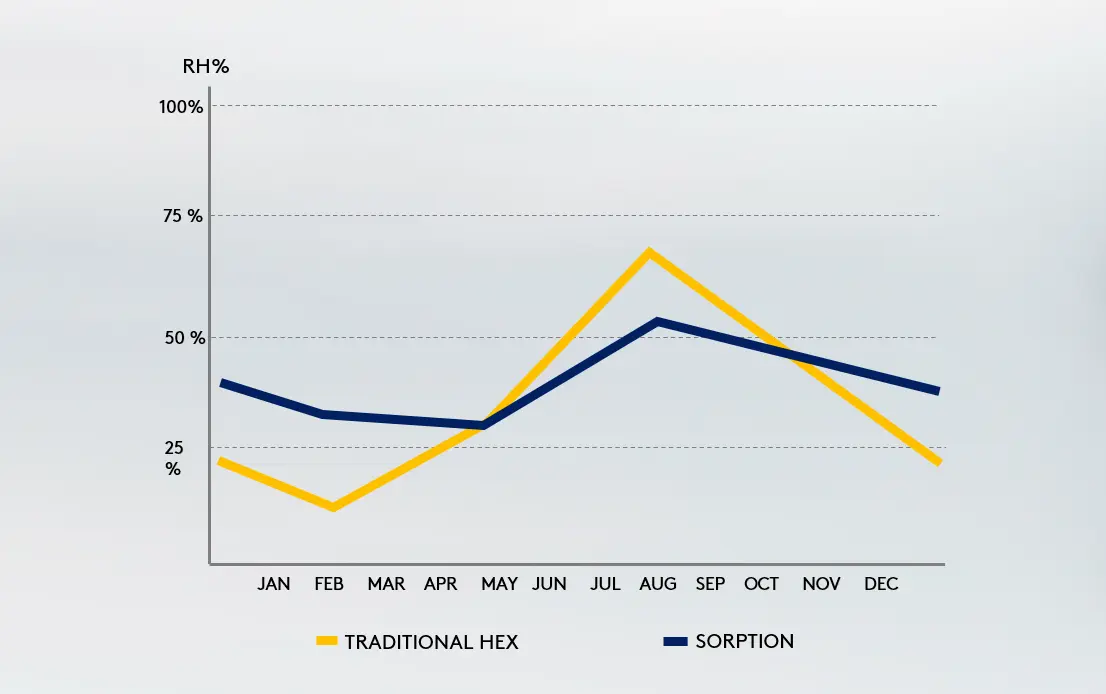
Enthalpy/sorption technology enables the ventilation unit to recover up to 80% of indoor air humidity. Automation continuously monitors and adjusts indoor air humidity as needed.
In dry winter air, it can increase indoor humidity by approximately 15–20%, and in summer, it can similarly reduce indoor humidity by 15–20%.
Humidity recovery and sensors are built directly into the ventilation unit, allowing the system to operate fully automatically without requiring any additional devices in the living space.
Benefits of humidity optimisation
enthalpy/sorption
In winter:
- Keeps indoor air humidity approximately 15–20% higher.
- Healthier for both people and structures.
- Eliminates excessive humidity spikes caused by human activities (intelligent humidity automation).
In summer:
- Keeps indoor air humidity approximately 15–20% lower.
- Enhances cooling efficiency and reduces energy consumption (with condensing cooling).
- More comfortable for people and safer for structures.
Additional benefits:
- Minimizes the need for defrosting in ventilation.
- Saves energy (better annual efficiency).
- Airflows are always balanced.


How humidity optimisation saves energy?
Humidity optimisation can improve the energy efficiency of ventilation.
Due to the humidity recovery, the heat exchanger does not condense. In other words, the ventilation unit normally doesn't need defrosting cycles, which improves the annual efficiency of the unit.
Air flows also remain balanced, and the unit doesn't produce excessive negative pressure during frost periods. If the apartment has condensing cooling (e.g. an air-source heat pump), reducing indoor humidity makes cooling more efficient and also reduces the energy consumption of the cooling unit.
Humidity recovery with different types of heat exchangers
Yearly humidity variations inside apartment with traditional counterflow heat exchanger and sorption rotor:
How sorption technology actually works?
GUIDE
Rotary heat exchangers with a sorption coating bring significant benefits, but what exactly is it that make them so advantageous?
Read our step-by-step guide to understanding how sorption rotor technology really works.

AHUs with humidity optimisation
Swegon offers a wide range of air handling units with enthalpy and sorption heat exchangers suitable for residential ventilation.


